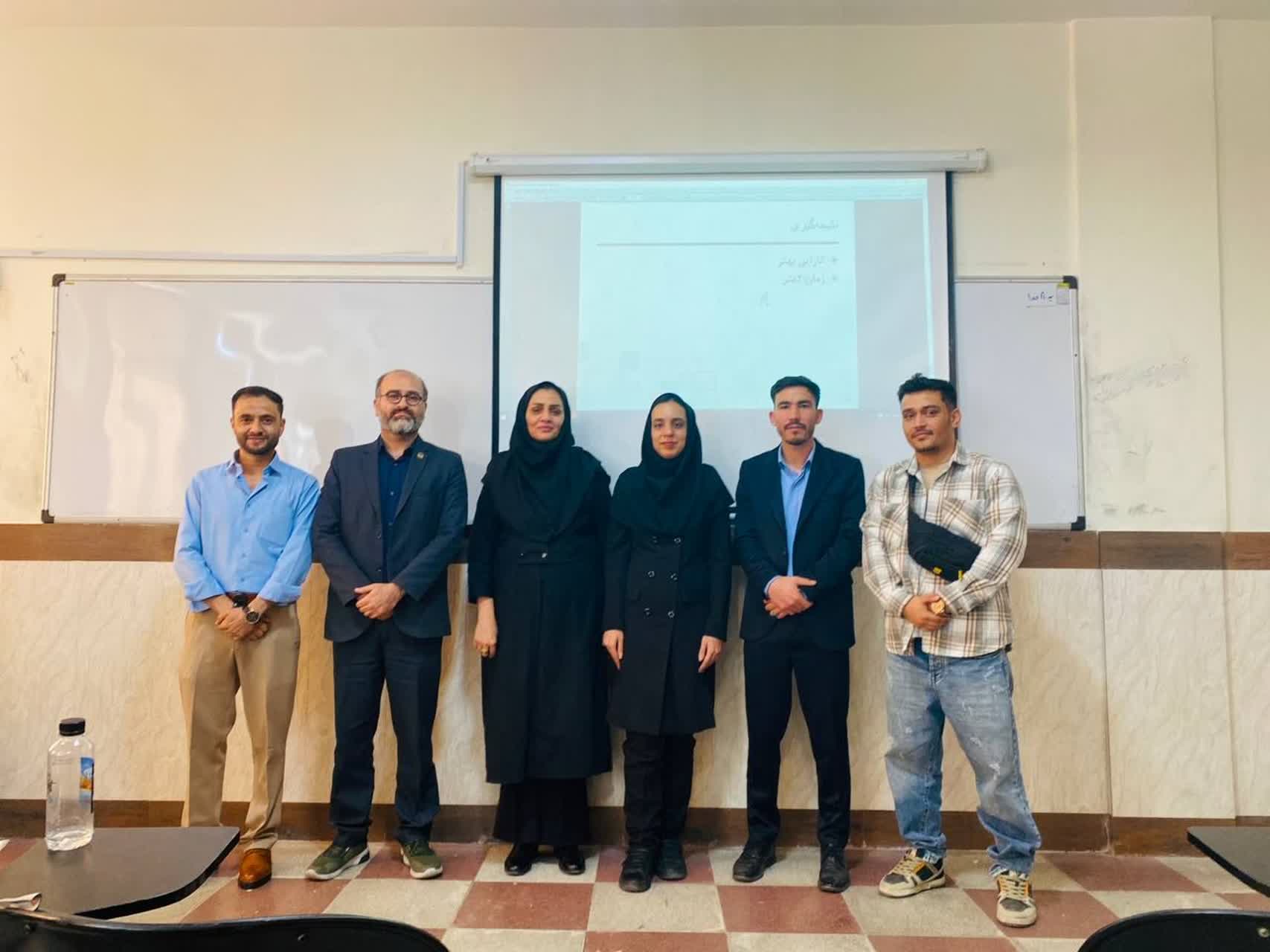
Defense of Theses by the First International Master’s Students in Computer Engineering (Software Engineering)
The first cohort of international master’s students in Computer Engineering (Software Engineering) successfully defended their master’s theses.
On October 22, 2025, Nematollah Kamali defended his thesis entitled “Maximizing Influence in Social Networks Using Harris Hawks Optimization (HHO) Based on Edge Weighting and Closeness Methods”, and Seyed Sadegh Hashami defended his thesis entitled “Predicting Cosmetic Surgeon Performance Based on Limited Surgical History Data Using Generative Artificial Intelligence”. Both theses were supervised by Dr. Azadeh Tabatabaei.
According to the abstract of Mr. Hashami’s thesis, predicting facial cosmetic surgery outcomes prior to the operation can serve as an innovative approach in the field of medical imaging, playing a vital role in improving surgical planning and postoperative outcomes. By leveraging advanced deep learning techniques, highly accurate visual representations of surgical results can be generated before the procedure, along with improved postoperative patient care planning. This approach not only enhances patient satisfaction but also assists surgeons in performing procedures with greater precision. Such predictive tools effectively act as intelligent assistants for surgeons, contributing to reduced postoperative complications and faster patient recovery.
In this study, a combination of advanced generative artificial intelligence techniques and limited historical surgical data is investigated to predict cosmetic surgeon performance. The primary objective is to improve the accuracy, reliability, and robustness of cosmetic surgery outcome predictions using machine learning models, including Vision Transformers and state-of-the-art deep learning approaches such as Generative Adversarial Networks (GANs).
To address the challenge of limited training data, self-supervised learning and multi-stage learning approaches are employed, enabling models to learn effectively even from sparse and heterogeneous datasets. Furthermore, multimodal self-supervised learning techniques—such as contrastive learning, reconstructive learning, and predictive learning—are used to integrate diverse data types and enhance the overall intelligence of the system.
The results demonstrate that the intelligent application of these methods can significantly support medical decision-making. Finally, a review of existing studies on facial cosmetic surgery prediction indicates that, to date, no similar model has been available for predicting facial cosmetic surgery outcomes prior to surgery.